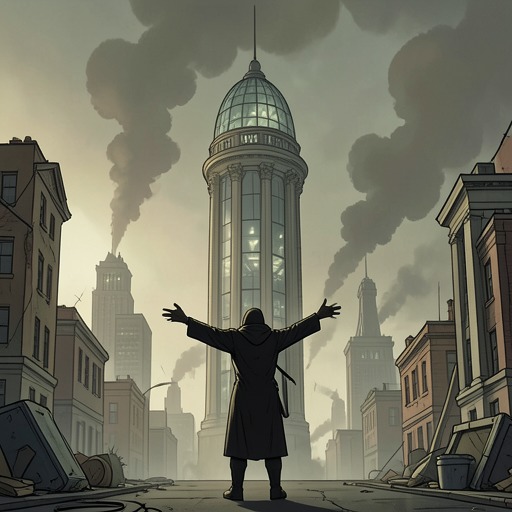
Alternative after society order
Klara and the SunThe post-substitution social order is the social landscape formed by technological change, genetic enhancement, and the displacement of established forms of work. Its consequences reach into careers, schooling, family life, and relationships: the Father describes substitution as a route toward a more considered life, while Rick’s prospects reveal how institutional limits can persist even for a capable student. The order is neither uniformly celebrated nor simply condemned; its benefits, exclusions, and meanings vary with the networks of support available to each person.
Work, Displacement, and Adaptation
The Mother’s account of her employment gives the changing world a specific institutional texture. She reports a reduced campaign budget, chronic conflict with public-relations staff, and a workplace in which Steven continues to make his presence felt. The Father asks whether it is worth her continuing to hold on to her position in the legal department at Goodwins, suggesting that her work consumes her waking life because of a contract signed long ago. She resists his suggestion that she leave: in her view, stopping would cause both her world and Josie’s to collapse. Their exchange shows that professional change is not experienced as a clean transition. The Mother remains bound to a work structure she finds burdensome, partly because she believes her family depends on her continuing to sustain it.
The Father offers a markedly different interpretation of technological substitution. He tells the Mother that the changes were the best thing that happened to him: losing his former professional role, he says, forced him to see the world afresh and distinguish what matters from what does not. He now lives among people who also came through the same changes, including some whose former careers had been grander than his. They acknowledge bad days, but say they feel they are living more fully than before. In a later conversation, he repeats that he is glad in many ways to have lost his job, while disputing that he simply lost it: he frames the outcome as part of changes that required everyone to find new ways to live.
That claim is not an uncomplicated celebration. The Mother reminds him of his former talent, experience, specialist knowledge, and the fact that no one can now make use of them. The Father’s answer stresses the difference between professional status and a decent life: his new community has helped him value the latter, even as his daughter’s illness and the choices facing his family keep the costs of change close at hand. His outlook also unsettles the Mother, who appears more bitter about his displacement than he is. The novel therefore presents substitution as both a loss of recognized work and an opening toward a different conception of fulfilment.
Education and Unequal Opportunity
The order’s inequalities are especially visible in education. The Mother tells Josie that being clever is not enough; children must learn to get along with others, and interaction meetings are preparation for the varied company they will encounter in college. She contrasts her own years spent alongside other children with the thinner social experience of Josie’s generation, warning that children who do not attend enough meetings tend not to do well in college. The advice makes social participation part of educational preparation, not merely a matter of personal comfort.
Rick’s situation exposes how that preparation and opportunity are distributed. Although he is described as clever, he was never lifted, and the ordinary route of screen tutoring is closed to him: tutors belonging to TWE are forbidden to teach unlifted students, while other tutors demand fees his family cannot afford. The Mother explains that Atlas Brookings is the only proper college still admitting a small number of unlifted students. Its commitment to that principle offers a real possibility, but the places are few and competition is severe. Later, the odds are described as below two percent, making the difference between theoretical eligibility and a viable chance unmistakable.
Josie urges Rick to study harder and try for Atlas Brookings, insisting that he is smart and that even her mother believes he has a chance. Rick resists because he sees the admission probability as negligible; Josie counters that he is smarter than the other unlifted applicants and accuses him of letting his mother’s wish to keep him close determine his choices. The disagreement links educational access to family attachment as well as formal policy. Support can encourage Rick, but it cannot remove the admissions limit, the absence of affordable tutoring, or his uncertainty about whether effort can overcome those barriers.
The family’s support network also reveals the practical work needed to keep a restricted path open. The Mother cannot provide the expert academic guidance Rick needs, and his family cannot pay the fees demanded by tutors outside TWE. When the Mother hears that Klara has arrived next door, she sees a possible way to help; Rick immediately objects to taking the plan further. Years later, the Father praises Rick’s drone system as impressive and says that genuine ability deserves recognition regardless of whether its creator was lifted. Rick explains that he developed the system himself, using online information and books his mother ordered, without tutors. His independent work demonstrates ability, but the need to assemble learning from personal resources also makes visible the support ordinarily denied to him.
Enhancement, Artificial Companionship, and Social Belonging
Genetic enhancement is woven into ordinary social judgments and consumer choices. When the Mother asks which model Klara is, the Manager identifies her as a third-series B2 and recommends her as a companion who can encourage a conscientious, studious attitude. The Mother says that Josie could use such encouragement, and Josie declares the artificial friend perfect. This purchase joins a child’s education and companionship to a marketed model, while the Manager’s recommendation presents the artificial friend as one response to a perceived need within a family.
The social consequences of enhancement appear in both children’s relationships and the rules governing opportunity. Josie complains that the other children at her interaction meeting are not her friends, although her mother sees regular meetings as essential preparation for college. Rick, her preferred guest, is a neighbor and a close companion, but he is also an unlifted child whose educational path differs from hers. Josie tells him that he should pursue the college she can attend; the practical distance between their prospects strains the future they have imagined together. The novel thus connects social exclusion to education: a child may be present in a peer group yet feel alienated from it, while a talented neighbor may face a narrower institutional route because of enhancement status.
Klara’s observations complicate the judgment that social behavior simply divides the kind from the unkind. After the meeting, she recognizes Rick’s fear that Josie might become like the other children, but believes Josie remains kind beneath her unusual behavior. She also interprets the peers’ roughness as possibly arising from their fear of loneliness. The moment does not erase the distinctions imposed by the social order; instead, it shows how loneliness can shape conduct on both sides of a divide. Belonging is presented as a scarce and vulnerable good, not something guaranteed by status, intelligence, or proximity.
Klara herself is situated within this world as an artificial companion whose capacities are defined in part by the model she embodies. When the Father apologizes for assuming she can smell, she explains that she has no sense of smell; he suggests that B3s may have been given limited smell for safety reasons, but Klara says she has none. Her account makes technological design concrete through a specific absence, while distinguishing her B3 capabilities from the B2 model the Manager previously recommended. Artificial companionship is therefore not presented as a single, uniform condition: models are differentiated, marketed for particular purposes, and marked by limits.
Community, Conflict, and the Meaning of Progress
The Father’s new community carries the promise of belonging after displacement, but its description also exposes tensions in the changed social order. He tells Josie that he stays because it is his community and because he shares his life with fine people who have traveled a similar road. He believes they have found different ways to lead decent and full lives. When Helen apologizes for calling him and his friends fascists, she explains that his earlier description—white former professional elites, extensively armed against other groups—had sounded that way to her. The Father rejects the label and objects to Josie and Rick hearing it, while acknowledging that different groups live in the area and arguing that they need to defend what they have if others will not respect them.
This exchange leaves the community’s security and self-understanding in tension. The Father experiences it as a source of mutual support and a place where life can be remade; Helen hears the combination of social homogeneity and arms as troubling. The Father does not deny that groups have divided, but rejects the interpretation that his community is fascist. The novel gives neither account a simple resolution. Instead, the same material conditions can be described as protection by those inside the community and as a warning sign by someone looking at it from outside.
The contrast between the Father’s account of a fuller life and the Mother’s fear that her own world would collapse if she stopped working also resists a single verdict on progress. The changes have reorganized more than careers: they affect who can obtain tutoring, who is likely to enter college, where former professionals find community, and how families try to secure a future. Personal resilience can create new forms of meaning, but it does not make unequal rules disappear. Rick’s talent is acknowledged, yet access remains scarce; the Father has found a valued community, yet that community is shaped by division and armed defense.
Separate Futures and the Limits of Opportunity
The long-term consequences of this social order emerge in the diverging lives of Josie and Rick. After Josie recovers, she works hard on her tutorials, and she and the Mother argue over which college she should attend. The Father disagrees with both of their views and once comes to the house to press his own position, an unusual visit that the family understands has broken a rule. Josie also spends more time away, visiting other young adults and attending retreats as part of her preparations for college, though she tells Klara little about those experiences.
Rick’s life moves in a different direction. He continues to visit regularly in the early period after Josie’s recovery, but comes less often as she travels and he becomes occupied with projects of his own. He buys a car called the Wreck and drives into the city to meet new friends. Rather than park at his house, he leaves the car among the loose stones because he finds that a more convenient starting point than the narrow, circuitous way out of his home. By then, it is increasingly the Wreck, rather than Josie, that brings him to the house; the car’s presence marks a practical change in the pattern of their contact.
Klara notices the contrast: Rick and Josie continue to show kindness to one another, yet prepare for very different futures. When she raises her worry, Rick recalls her earlier question about whether his love for Josie was genuine and everlasting, and understands why their separate plans trouble her. The separation is not presented as proof that their affection has vanished. Instead, the novel places enduring kindness beside diverging opportunities and choices, showing how the post-substitution order shapes possible futures without dictating every feeling that survives between them.